
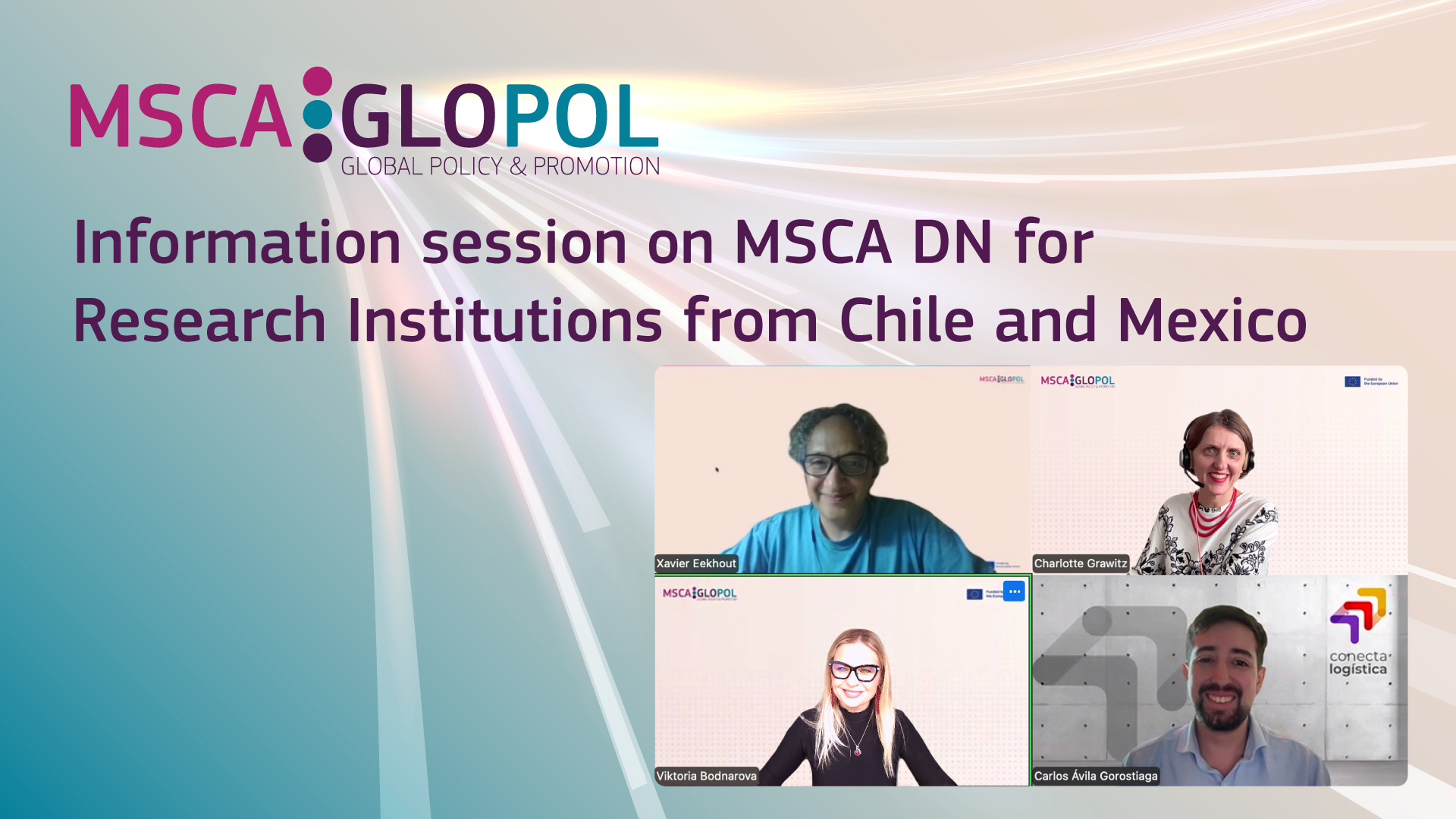
On May 27, 2026, the GLOPOL-MSCA project, in collaboration with EURAXESS LAC, successfully hosted a targeted virtual information session titled “MSCA DN for Research Institutions from Chile and Mexico.” Designed specifically for researchers, international office staff, and science, technology, and innovation (STI) representatives, the webinar aimed to break down barriers to participation in the Marie Skłodowska-Curie Actions (MSCA) Doctoral Networks. Overcoming the challenges faced by regional organizations no longer directly funded by Horizon Europe, the session provided crucial clarity on eligibility and funding mechanics for non-associated third countries. The event drew strong interest from the regional scientific community, bringing together 33 active participants representing universities and private sector organizations across Latin America and the Caribbean. Find the opening presentation here.
Moving beyond purely theoretical guidelines, the webinar offered a highly practical, evidence-based approach to international collaboration. Attendees received expert strategic guidance on implementing doctoral networks from Xavier Eekhout Chicharro (MSCA NCP, FECYT) (find his presentation here), which was paired with a compelling real-world case study from Carlos Ávila Gorostiaga of Conecta Logística in Chile regarding the MSCA DN POTENT project. The session concluded with an energetic, interactive Q&A period, effectively fostering closer ties between the European Research Area (ERA) and the Latin American research ecosystem. By equipping institutional leaders with actionable insights, the webinar successfully paved the way for new, high-quality global partnerships designed to address shared global challenges.

Leave a Reply