
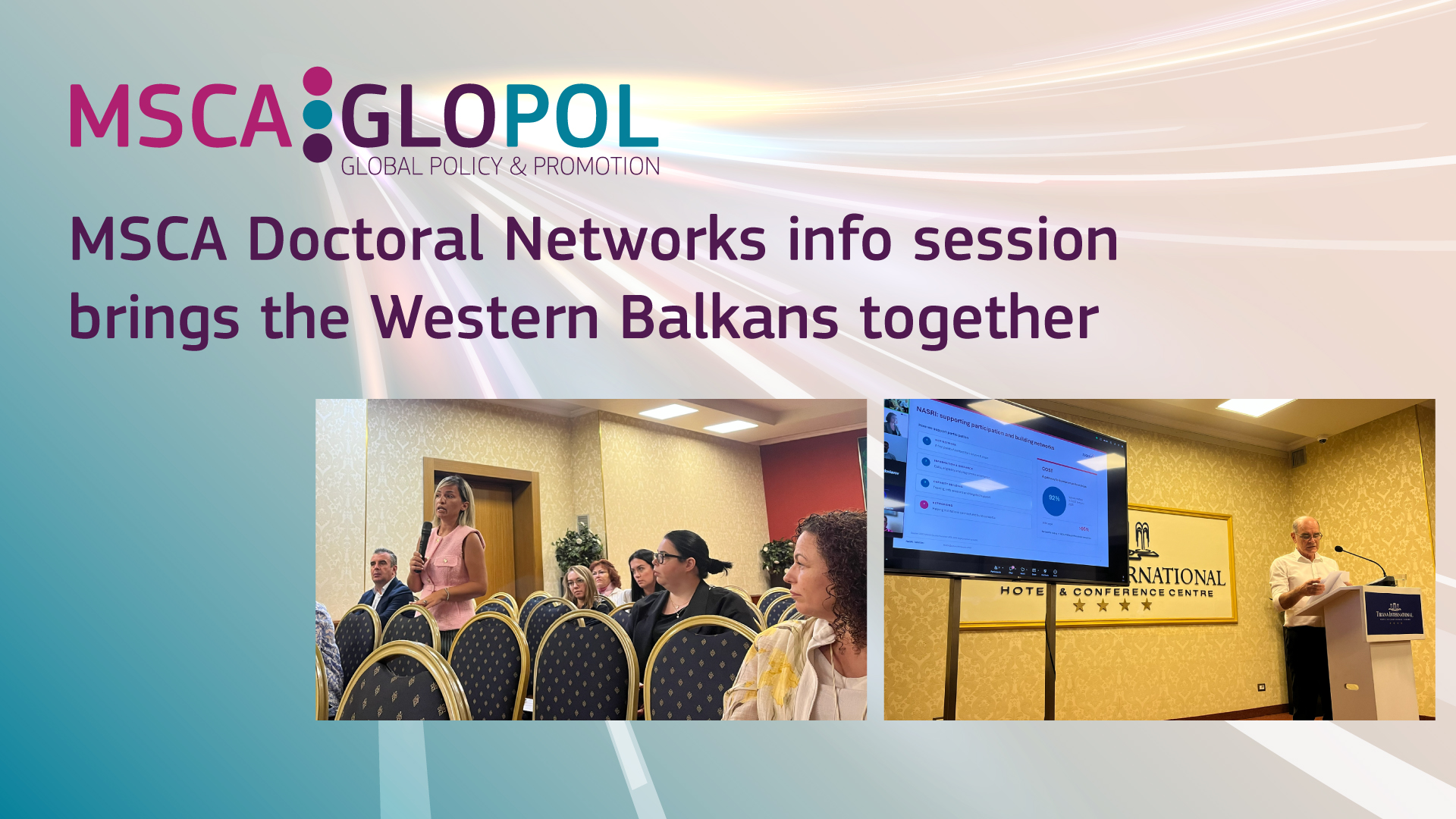
On 16 September 2026, MSCA-GLOPOL, in cooperation with the Albanian National Agency for Scientific Research and Innovation (NASRI), organised a hybrid information session in Tirana dedicated to the Marie Skłodowska-Curie Actions (MSCA) Doctoral Networks and opportunities for organisations across the Western Balkans.
Hosted at the Tirana International Hotel, the event welcomed participants from Albania, Kosovo*, Bosnia and Herzegovina, Montenegro and Serbia. The audience consisted primarily of representatives of universities, research institutions and National Contact Points (NCPs), alongside participants from the non-academic sector.
The session aimed to support potential applicants from the Western Balkans interested in the open MSCA Doctoral Networks call, combining information on the call with practical guidance on proposal preparation, partner search and consortium building.
The event opened with welcoming remarks by Cristina Gomez, representing MSCA-GLOPOL. Dimitar Radoslavov from the European Commission’s Directorate-General for Education, Youth, Sport and Culture (DG EAC) then provided an overview of the MSCA Doctoral Networks action, followed by Robert Dumi, Director of the Department of International Affairs at NASRI and MSCA NCP for Albania, who presented the key features and requirements of the current Doctoral Networks call.
The second part of the programme focused on practical experience and applicant support. Prof. Mirko Djurovic, Director of the Institute of Marine Biology in Montenegro, shared first-hand experience from a successful Doctoral Networks application, covering key aspects ranging from building the partnership and structuring work packages to project management and the added value of MSCA participation for the institution. Filip Petrovic, NCP at the University of Montenegro, complemented this perspective with practical advice for applicants and highlighted how NCPs can support organisations throughout the application process.
Recognising that partner search and consortium building remain important challenges for potential applicants in the region, the final part of the event introduced matchmaking platforms and resources that can help organisations identify suitable partners and develop collaborations for future Doctoral Networks proposals.
The session also provided participants with an opportunity to raise questions directly with experienced MSCA participants and regional NCPs. Presentations and resources from the event were subsequently shared with registered participants to extend the impact of the session and support their preparations beyond the event itself.
Presentations
Cristina Gomez – MSCA GLOPOL Project
Dimitar Radoslavov – MSCA Doctoral Networks: General Overview
Robert Dumi – MSCA Doctoral Networks 2026 Call
Prof. Mirko Djurovic – Experience from a Successful Doctoral Networks Application
Filip Petrovic – Practical Tips and NCP Support
Cristina Gomez – Matchmaking Platforms and Resources


Leave a Reply