
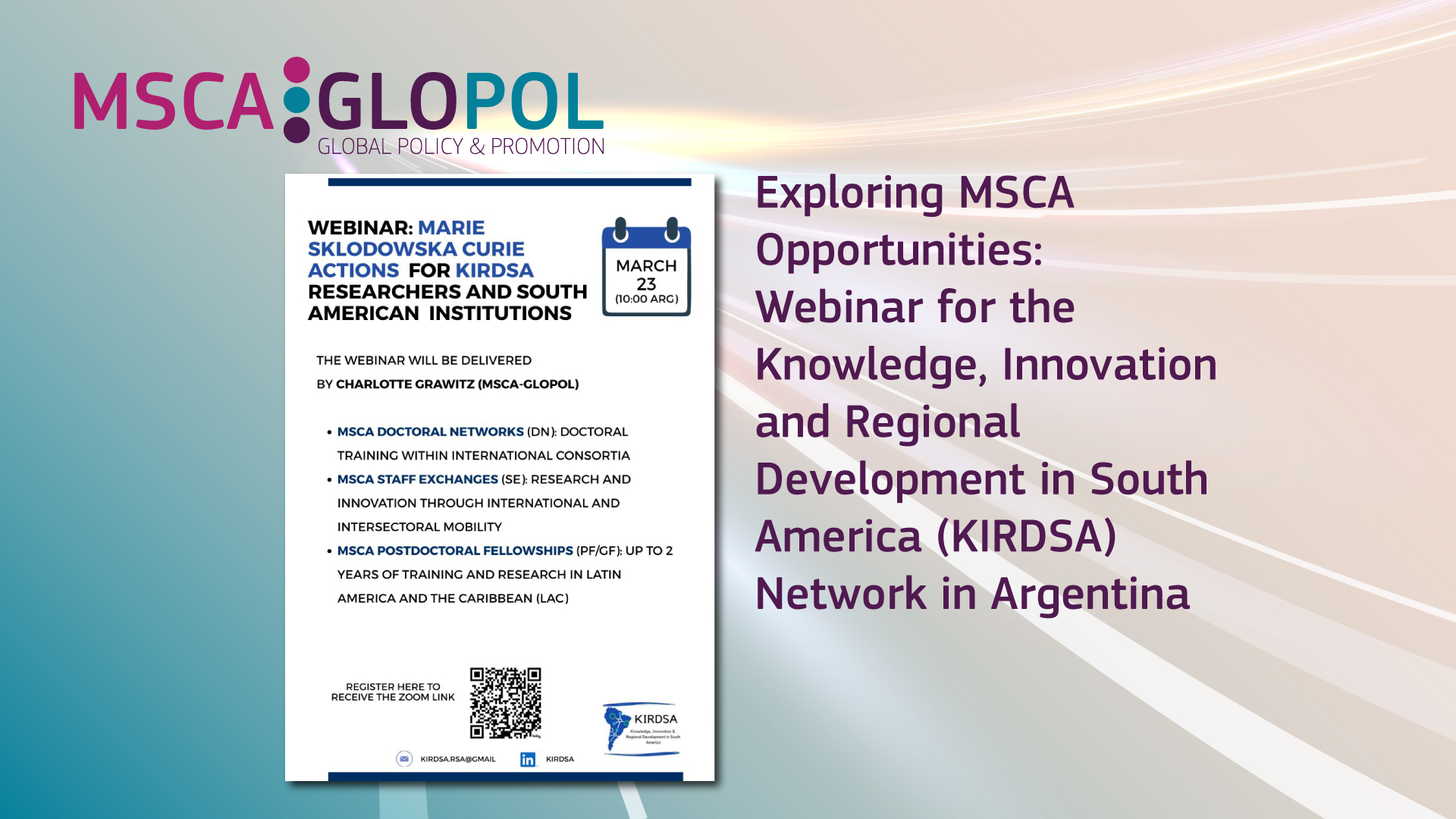
On 23 March 2026, the MSCA-GLOPOL project delivered an online webinar for members of the Knowledge, Innovation and Regional Development in South America (KIRDSA) network, hosted from Argentina. Presented by Charlotte Grawitz (MSCA-GLOPOL), the session provided an in-depth overview of the Marie Skłodowska-Curie Actions (MSCA) funding opportunities under Horizon Europe, with a particular focus on schemes most relevant for Latin America and the Caribbean (LAC), including Doctoral Networks, Staff Exchanges, and Postdoctoral Fellowships (Global Fellowships). The event built on a recorded overview of Horizon Europe delivered during the KIRDSA conference in Buenos Aires in February 2026, offering participants a more detailed and interactive engagement with MSCA calls.
Bringing together approximately 10 South American researchers and professionals, the webinar fostered dialogue around bi-regional collaboration prospects and practical guidance on MSCA eligibility and application processes. Organised in partnership with KIRDSA and supported by MSCA-GLOPOL, the online event reinforced ongoing efforts to strengthen research and innovation ties between Europe and Latin America. The event served as a meaningful step towards building the capacity of LAC institutions to engage with Horizon Europe and contributed to laying the groundwork for future MSCA project partnerships.
The presentation delivered by Charlotte Grawitz (MSCA-GLOPOL) is available here.

Leave a Reply