
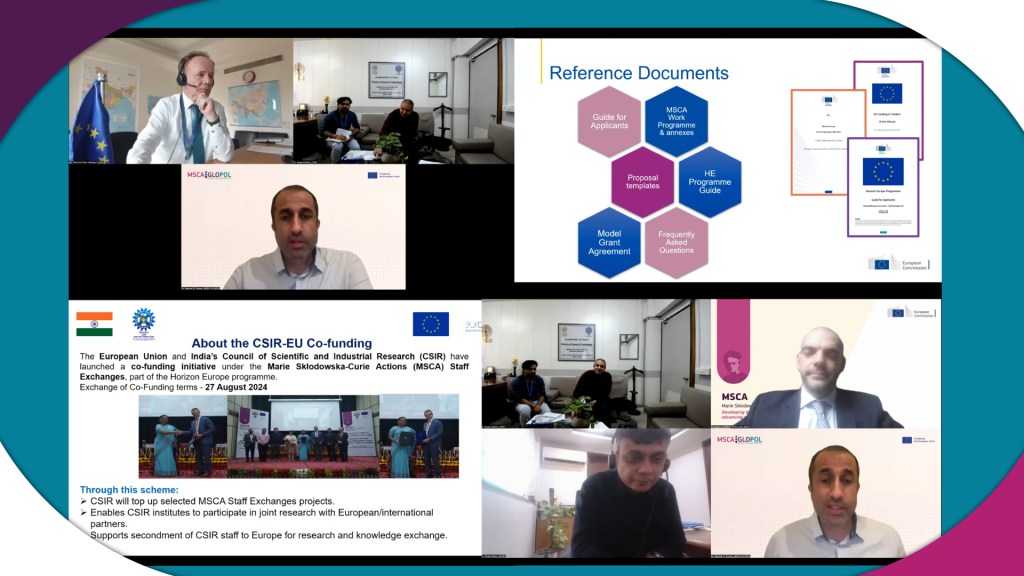
On 16 February 2026, MSCA-GLOPOL, in cooperation with Council of Scientific and Industrial Research (CSIR) India, the EU Delegation to India, European Commission Directorate-General for Education, Youth, Sport and Culture (DG EAC), and with the support of EURAXESS India, organised a Networking and Brokerage Webinar dedicated to the 2026 MSCA Staff Exchanges Call with CSIR co-funding partnership. The online event brought together researchers, research managers, and institutional representatives from India and Europe to explore funding opportunities and strengthen EU–India collaboration under Horizon Europe.
The webinar provided a comprehensive overview of the MSCA Staff Exchanges, including its objectives, eligibility conditions, secondment structures, and financial rules. Particular attention was given to the CSIR co-funding mechanism, outlining the specific eligibility criteria and participation modalities for CSIR-affiliated researchers.
Beyond the informational component, the event emphasised active networking. Selected participants presented short pitches outlining their research expertise, institutional strengths, and collaboration interests. These exchanges enabled researchers to identify complementary partners and explore potential consortium configurations for the 2026 call.
The interactive Q&A sessions allowed attendees to clarify technical and administrative aspects of proposal preparation. The event concluded with strong interest in follow-up matchmaking and proposal support activities, reinforcing the shared commitment to enhancing EU–India research mobility and intersectoral cooperation through MSCA Staff Exchanges.
The presentations delivered during the event are available below:
- “Presentation of the 2026 MS-SE Call”, Evangelos Daskalopoulos, Project Advisor, European Research Executive Agency (REA), European Commission. Download it here.
- “Presentation – MSCA-Staff Exchange – CSIR -Co-funding Modalities”, Dr. Anand Mohit, CSIR – International S&T Affairs Directorate, Government of India. Download it here.
- “Emerging Photovoltaics”, Dr. Jai Prakash Tiwari, CSIR–National Physical Laboratory, India. Download it here.
- “Waste polyethylene deconstruction”, Dr. Samir H. Chikkali, CSIR-National Chemical Laboratory, India. Download it here.
- “Biobased Polyurethanes and Nanocomposites for Functional Applications”, Dr. K.I. Suresh, CSIR-National Institute for Interdisciplinary Science & Technology, India. Download it here.
- “Innovation for Geoinformation”, Mr. Jürgen Bund, Head of International Cooperation, GEOkomm e.V, Germany. Download it here.
- “R&D of Advanced Materials and Waste to Wealth Processes”, Mr. Sandeep Singhai, CSIR-Advanced Materials and Processes Research Institute, India. Download it here.
- “Zero-Defect Micro/Nano Manufacturing for High-Precision Optics and Advanced Devices“, Dr. Neha Khatri, CSIR-Central Scientific Instruments Organisation. Download it here.
- “Strategic Intercultural & Innovation Brokerage for EU3India R&I Mobility”, Ms. Hélène Abrand & Mr. Clément Thomas Brebou, HAC & Ecopolab, France & Spain. Download it here.
- “Crystalline defects engineering for optimizing functional properties”, Dr. Nirmal Kumar Velu, CSIR-Institute of Minerals and Materials Technology, India. Download it here.
- “SLCP (Methane & Black Carbon) Emission over India and its global impact through Climate Modelling”, Dr. Saroj K. Sahu Department of Environmental Science Berhampur University, India. Download it here.
- “Atomically dispersed cocatalyst decorated catalyst for selective co2 conversion to value-added chemicals”, Dr. Yatendra S. Chaudhary, CSIR-Institute of Minerals and Materials Technology, India. Download it here.
- “Neurovskite: lead free halide perovskite memristors for energy-efficient neuromorphic computing”, Dr. Vijayakumar Chakkooth, CSIR-NIIST, India. Download it here.


Leave a comment